

Desperation and dinner parties, in real life, really don’t mix. We put so much pressure on ourselves to act like real adults. We buy the right wine, impressive but not too expensive, arrange the cheese and crackers just so, clean the apartment in a frenzy, dress and redress ourselves to appear put together but not like we’re trying too hard, and choose the perfectly curated playlist to set the tone. All to impress the friends we’ve invited over. We’re frazzled, and we can’t even remember why we wanted to have people over in the first place, and then the doorbell rings.
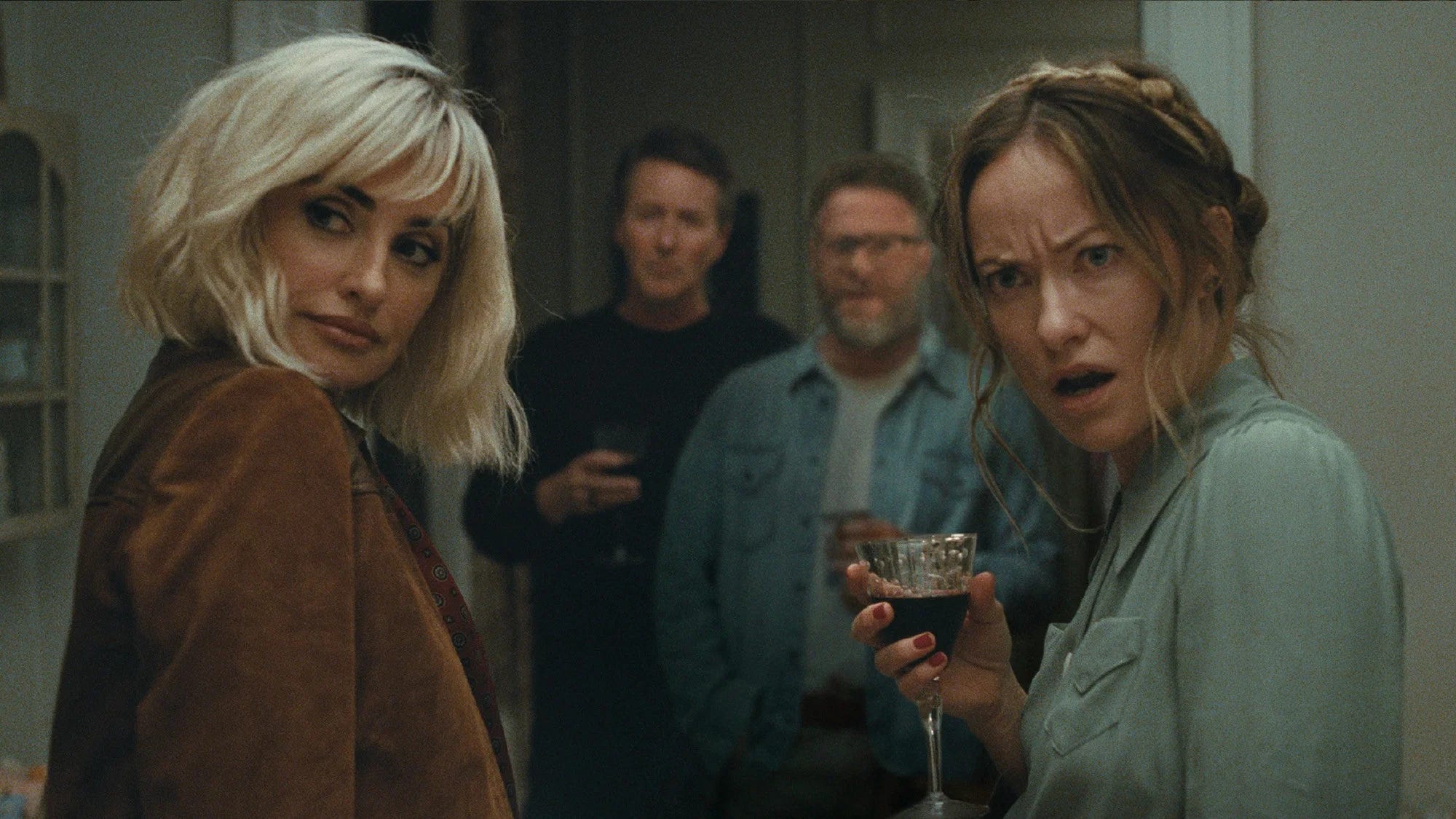
But in Olivia Wilde’s newest directorial effort, The Invite, this particular kind of zany, manic social adventure makes for a hilarious night at the movies. The Invite is the English-language version of the much-adapted 2020 Spanish film The People Upstairs. The premise is a familiar, well-worn setup, designed to feel familiar but full of delicious surprises. Joe (Seth Rogen) and Angela (Olivia Wilde) play the hosting couple, who are long married and long overdue for a romantic reset. Angela has hastily arranged to send their daughter away for the evening so that she can invite their upstairs neighbors Hawk (Edward Norton) and Pína (Penélope Cruz) over for wine and cheese. Except Joe didn’t buy the wine, and Pina doesn’t eat cheese.
After an establishing sequence showing Joe commuting home across the Bay Area from his unfulfilling teaching job, rumpled and crabby, while Angela spares no expense and pours over every detail of their meticulous San Francisco apartment ahead of their guests’ arrival, the first twenty minutes play out about how you expect. Joe and Angela circle each other like neurotic sharks, bickering and belittling each other mercilessly. Joe is blindsided by the party and furious at Angela for inviting them. Hawk and Pína, it seems, have loud, performative sex at all hours, enraging Joe and intriguing Angela. Exposition peppers their rapid-fire, vicious banter, and just as their arguing reaches its climax, Hawk and Pína come knocking.
What happens next is predictable enough. Joe and Angela try and fail miserably to conceal their resentments, while Hawk and Pína seem to flaunt their eccentric and progressive relationship, putting Joe and Angela’s dry and bitter marriage into stark relief. The evening unfolds in long, excruciatingly awkward scenes that sizzle with tension and intrigue. I would hate to be a guest at a party with this “contentious environment” (as Norton’s Hawk describes it), but from the comfort of my movie theater recliner, it’s hard to look away.
Back after a few years away from being behind the camera, Wilde takes calculated risks here. She guides intricate, dialogue-heavy scenes through a thousand microshifts and eddies of emotional turmoil. Her strength is in directing actors toward specificity, drawing an audience in with well-timed jibes and self-effacing humor. And her cast is superlative. In lesser hands, these characters and their evening of upper-middle-class restlessness would feel trite and strained. But here, it’s alive and bright with moments of zesty clarity and releases of comedy. Cruz and Norton, in particular, handle their parts with exactitude. Playing both into and against the types their characters exemplify, they make Hawk and Pína funny and believable, not letting the more obviously comedic moments play just for laughs. They raise the bar for this sweaty, horny quartet. Wilde is in peak form here as well; her character Angela is a mess of nerves and wide-eyed fascination.
The production design and score deserve equally high marks here too. Jade Healy makes Jo and Angela’s apartment feel like a true reflection of their cluttered, hurried lives, packed with tasteful knick-knacks and appropriately claustrophobic. Devonté Hines’ score is so effective it feels like it’s coming out of the scene itself, not layering on top of it. Comedy is hard to get right, and a great score like this one shows how much value it can add. Beautifully lit and shot, The Invite feels…inviting. A warm, blue and green oasis that feels like a world unto itself, accentuating how insular and oppressive Joe and Angela’s lives have become.
Wilde’s direction in the group scenes is deft and free, allowing the actors (herself included) to intermingle, hang on the doorways and crowded corners, eyeing each other from across the space. The scenes are well blocked and well executed, but I can’t help feeling like the camera work was at times too overwrought and showy. At every opportunity, we see the characters’ reflections in bathroom or hallway mirrors, in window panes and in the spaces between rooms. Cross-talk and cross-cuts jerk the audience around to ratchet up the tension. It’s effective, but I found myself craving a visual style that was more patient, more measured, and more unobtrusive.
The original Spanish film is itself an adaptation of a play, and it’s easy to see the theatrical influences come into play here, as Wilde leans into the talky menagerie of four people all cooped up together, evoking classics like Who’s Afraid of Virginia Woolf?, for example. But there’s a stubborn unwillingness to let scenes breathe and unfold, an anxious-feeling reflex to jam-pack every moment with a joke, an eye roll, or a foible. The film has a sturdy arc, and I would even allow a moving conclusion, that in my opinion would feel more earned if there were a few more moments of silence, of considering, of letting the performances play out organically in the space, instead of cutting away and showing the audience how to feel in every moment, reflecting each agonized expression and raised eyebrow for maximum effect.
The performances are so well considered and lived in that all I could want as an audience member is a beat longer to really see them go from moment to moment, as great actors like these do. The film is highly entertaining, and successful in what it sets out to do. No doubt it will fuel many discussions at dinner parties this summer. And Wilde approaches the central themes of love, commitment, resentment, sex, and longing with tenderness, not judgement. It’s a refreshing take on the sex comedy: it’s a well-off but angsty set of middle-aged oddballs still managing to reach a clearer understanding of their neighbors, and themselves, by the end of the night.
Though the main conceit seems tailor-made for today’s rapidly evolving romantic and sexual landscape, Wilde is clever not to fall into the trap of making the film overly raunchy or shocking just for the sake of it. “Sex,” Pína tells Joe and Angela, “is not a thing you do, it’s a place you go.” The Invite shines when it lets its characters go there, and then go somewhere even more surprising all on their own. Wilde knows, as Hawk does, “Some people like to watch.” The Invite is an easy yes.
 | A guest post by
|