
Broadway's Ghosts: Blue Moon (2025)
Ethan Hawke shows off with one of the year's finest performances.

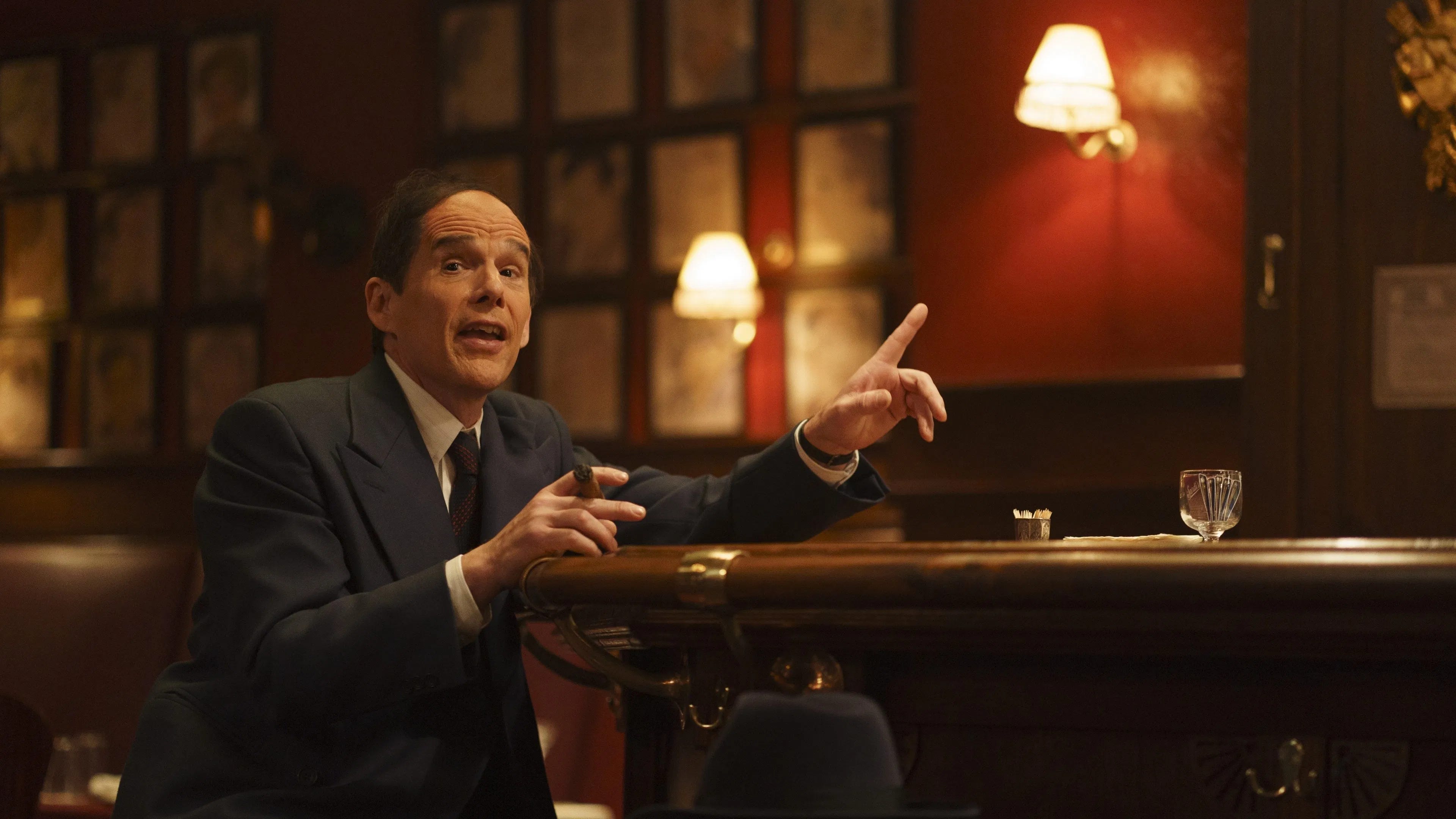
Sardi’s sits in the heart of the theatre district. It is not only literally tucked away at 234 West 44th Street, next to the Hayes and across from the Shubert, but it is where the writers and directors and producers and actors and dancers and critics congregate to host the conversation about the Broadway musical. This is no mere watering hole; it is the epicentre of the industry. These are the movers, these are the shapers, these are the people who fill the papers.
Their faces line the restaurant. Not just literally as they eat and drink, but in the famous caricatures placed in columns and rows across the crimson walls. While it was originally a hall of fame of sorts for the greatest stage names, from Al Jolson to Tallulah Bankhead to Bert Lahr, it later became an easy photog and publicity opportunity for Clay Aiken and George Clooney. But it doesn’t matter who stays there, as all of the cartoons hear the gossip and the rumors. They smile devilishly. They remember things we would like to forget. Sometimes, they even whisper back. There are ghosts in that building.
One of those ghosts is Lorenz Hart: ‘Larry’ to his friends, the drunk little man on the stool to anyone trying to slurp their spaghetti in peace. In Blue Moon, one of two films from this year by Richard Linklater (it only came out in October, but it is somehow not his most recent film - the other, Nouvelle Vague, his tribute to the French New Wave, is also about how and why artists create art), Larry is played by friend and frequent collaborator Ethan Hawke.
It is March 31st in the year 1943, one of the most consequential nights in Larry’s life. You see, he used to be one half of Rodgers and Hart, the songwriting duo who wrote 26 Broadway musicals together. Now, Richard Rodgers writes the music for Oscar Hammerstein II’s lyrics, and the team soon to be known as Rodgers and Hammerstein will become as synonymous with musical theatre as chorus lines and bad wigs. Dick and Oscar’s first musical, Oklahoma! (Larry pronounces it out, calling it “Oklahoma with an exclamation point” and comparing the punctuation choice to the garish nature of a man’s erect penis), opens tonight, and it’s a guaranteed goddamn hit.
Dick offered Larry the job first, after the Theater Guild suggested they adapt the folk play Green Grow the Lilacs for the musical stage. Larry bitched, and said no. He thought it was saccharine, flimsy fodder for the flyover states, and he correctly predicted that “high schools are going to put it on from now till doomsday, because it is so inoffensive.” He hates when things are inoffensive. He doesn’t trust them. He vacationed in Mexico instead.
Honestly, Dick was relieved. He could offer the wordsmith job to Oscar. Larry’s drinking had gotten out of control, so bad that Dick had to be physically present every time Larry wrote to guarantee he was working. Dick even had to finish the lyrics for a few of their most recent songs himself because Larry was out buying booze or already drunk or chasing tail or whatever the hell he was doing. No one knows that this drinking will lead to him being found dead in a gutter in just a few months at the age of 48.
That’s actually how Linklater opens his movie, with Hart passing out drunk on one of those classic New York rainy nights. Pneumonia was the doctor’s diagnosis, a broken heart was the true cause. When it flashes back to this night at Sardi’s, you know immediately that this will be the beginning of the end. Rodgers and Hart will never be Rodgers and Hammerstein. Pal Joey will never be Oklahoma! (with an exclamation point), much less The Sound of Music or South Pacific. And the next amber-filled shot glass may be the one he’ll never recover from.
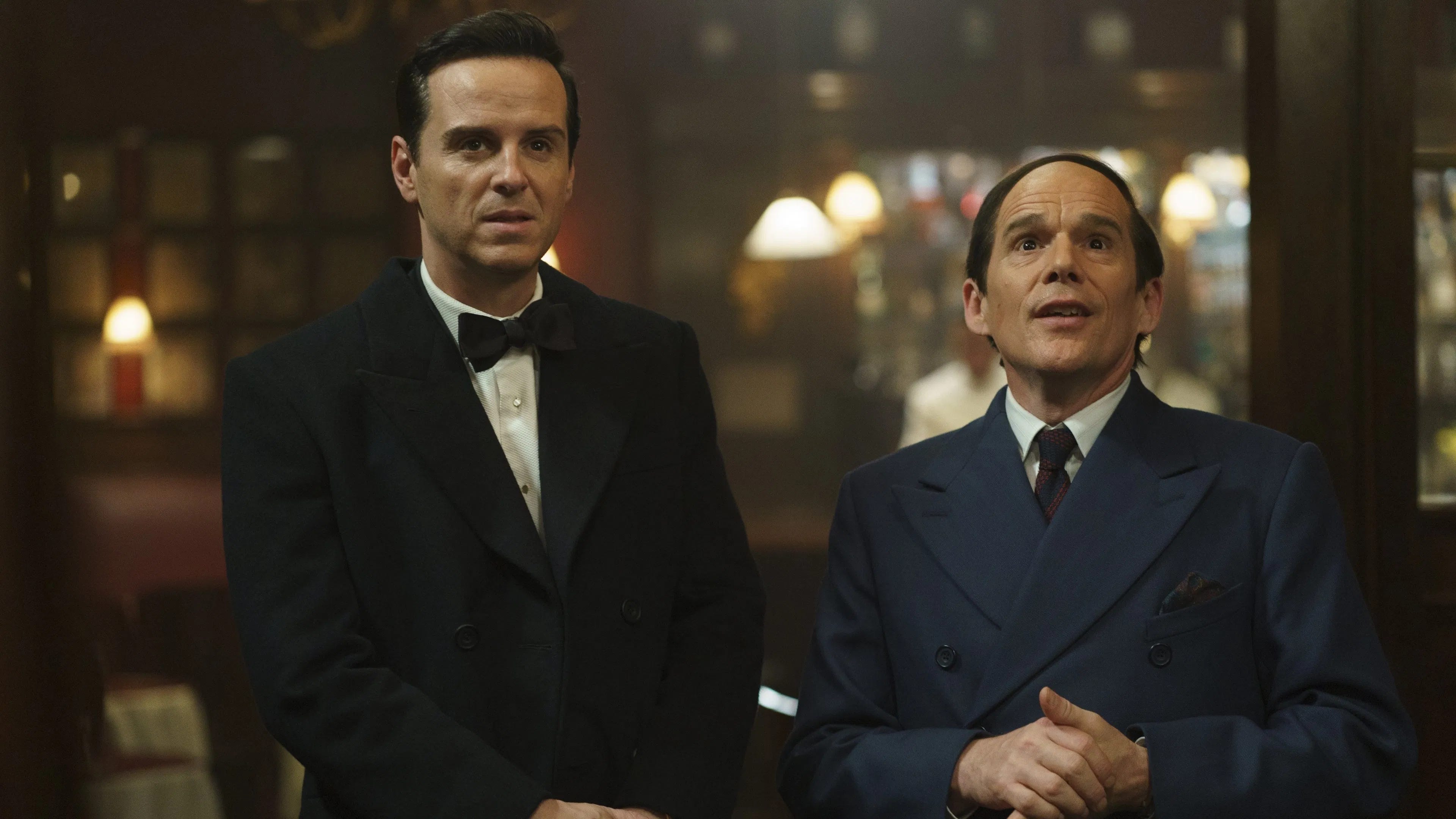
But tonight, Larry insists he’s not drinking. He asks the bartender, Eddie (played by Bobby Cannavale, as all good bartenders are), to pour him a bourbon just so he can look at it. He doesn’t just look at it for very long. Larry’s bitter, and he should be. Oklahoma! (with an exclamation point) will be more successful than any show he’s ever written, and we all know that it’s not a coincidence that it’s the first show Rodgers wrote without him. He admits that it stings, but only once. He lies when he says he isn’t jealous. The truest partnership of Larry’s life was his artistic collaboration with the man behind the keys (played by a brilliantly subtle Andrew Scott, the straight man to Hawke’s chatty bitch - Rodgers was once described as “more like a stockbroker than a composer,” and Scott plays that completely), the man who has left him for a better, more meaningful relationship. Sure, he gave Dick his blessing to work with Oscar, and yeah, they plan on revising and remounting one of their more imperfect shows this fall, but he, perhaps quite presciently, knows that it’s over now. He is not moody or pouty, he’s a sharp enough writing talent and Broadway broad, and he can recognize when the gig is up.
As soon as the curtain went up that night at the St. James Theatre, Alfred Drake’s booming baritone sang of the bright golden haze on the meadow, and the American book musical was changed forever. For the first time, characters did not sing to each other for the sake of singing, they sang to express themselves. The characters were unaware of their own singing and dancing, and the music and dialogue were used one in the same. The songs were a part of the play, not the thing that stopped a story cold.
Lorenz Hart was almost immediately obsolete, his stock-in-trade utterly irrelevant. Gone was the self-aware winking wit he wrote so well. And, for the better part of the last century, he has been forgotten, relegated to the footnotes of musical theatre history, which have skewed toward the meteoric impact Rodgers and Hammerstein had on American popular culture.
While Blue Moon gives Lorenz Hart a voice and, if you will, the spotlight center stage, it is really about how one man reacts to another man’s masterpiece. Stories of that night tell of Hart enjoying Oklahoma! (with an exclamation point) tremendously, “applauding, howling with laughter, and yelling bravos” during the performance, that he quite visibly “applauded the proceedings from a seat in Row B.” Though he heaps praise on the new duo after the show, Robert Kaplow’s screenplay imagines that he left his balcony seat early, partially because he was so deflated about the state of his career and the critical condition of New York culture, partially because he wanted to get to the party early.
You see, Sardi’s hosts great fucking parties. That’s where every show worth a damn has its opening night celebration. After the curtain call, everyone hugs each other backstage, celebrating the more-than-minor miracle they have all pulled off. They’re exhausted. Some are too tired to be exhausted. Costumes are peeled off bodies and thrown aside. A few champagne corks are popped, but most of the drinking is done at Sardi’s. The reviews will be in soon. For some shows, the party drinks because the reviews are in. For other shows, the party drinks because the reviews are in!
Tonight’s reviews confirm that the show is a smash. The New York World-Telegram will write that “Richard Rodgers has written for the show one of the finest musical scores any musical play ever had,” while the New York Journal American would say that “it has, at a rough estimate, practically everything.” Hart might’ve liked best the review from PM, which stated that “Mr. Hammerstein’s lyrics have less crispness and wit than Lorenz Hart’s at their best.”
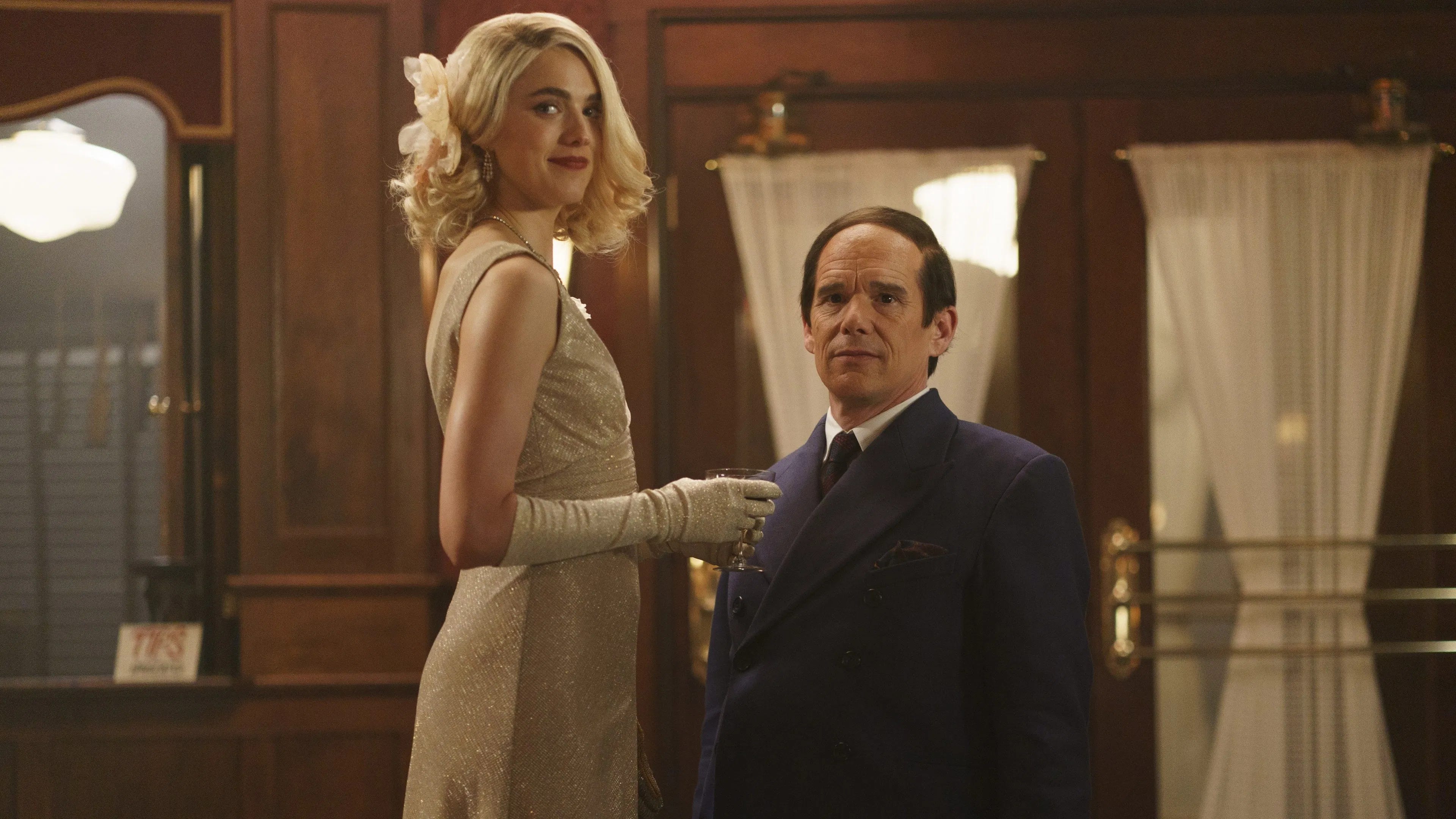
But for now, Sardi’s is quiet. The theatre usually starts at 8:00pm, so the restaurant is fairly empty after dinner until about half-past-10 because the shows are on. When Larry gets here, he’s the only one at the bar. That’s good for him, more conversation to be had with Eddie the bartender. When the five-foot-tall troubador saddles up to the stool, he is no taller and no shorter than he was standing. He sits, waiting for the radiant, half-his-age Elizabeth (Margaret Qualley), and holds court over the bar. Any time Larry does stand up and walk around, Hawke is made up to convincingly look an entire foot shorter than he really is. When she does arrive, fashionably late, Qualley in a pair of heels towers over him, often for great comedic effect. Larry really is just a little man, and even his own shoes with the elevator heels can do nothing to change that.
Richard Linklater loves to make his characters talk and talk and talk, and he especially loves it when Ethan Hawke talks. The Before trilogy is nothing but walking and talking, and it’s perhaps the most fruitful project of either man’s career. Blue Moon is a lot of sitting and talking, but that works too. While Kaplow’s words are imagined, Hart’s monologues all come from different parts of his real life. How he was never alone, but always lonely. How he could really feel sorry for himself. And how he loved being the center of attention.
Hawke himself is a theatre rat through and through, with New York performances of Shakespeare and Chekhov and Shepard and Stoppard, film credits playing Hamlet and Iachimo, and even his most recent novel, A Bright Ray of Darkness, is about a stage actor in a semi-autobiographical sort of way. He knows what it’s like to be a couple deep at Sardi’s. He brings that learned theatrical flamboyance to a role that demands it. It’s a flashy performance, showy in all of the right ways. He says to the viewer, “Look at how much fucking acting I can do.” A lot of film acting is inside out, feeling it from the depths of your body and letting it come out through your face without moving your eyebrows too much. That doesn’t work on stage, as the people in the cheap seats paid for a performance, too. Bringing the stage to the movies, Hawke delivers one of the finest of his career. This is a movie that has Andrew Scott, Margaret Qualley, and Bobby Cannavale, and doesn’t even need them.
Blue Moon, like Hart’s best songs, is about one thing, loving painfully and wanting to be loved deeply. Music in the night, a dream that can be heard, and how every note that’s sung is like a lover’s kiss. That’s what he seemed to be best at, after all. Men, women, it didn’t matter. A quick fling with the delivery boy, a failed marriage proposal to Elizabeth, it was the thing he thought about always. It was the thing he wrote about constantly. Shakespeare opened his finest comedy, Twelfth Night, with the oft-repeated “If music be the food of love, play on.” Hart opened his tune “Blue Moon” with the lyric, “Blue moon, you saw me standing alone, without a dream in my heart, without a love of my own.”
Larry was never loved the way he wanted or needed to be loved. He was always adored, never cherished. Loved, but not like that. In the months leading up to his death, Rodgers went to work with another man, and his mother, the only woman he ever lived with, and perhaps the woman who understood him most in the world, passed away. The drinking would increase. He would show up to his final opening night drunk as a skunk. Everyone would notice. Just a week later, an oxygen machine would help him take his final breath in a Manhattan hospital.
Still to this day, Larry likes a drink or two at Sardi’s. His face still hangs on the wall. Alex Gard, the restaurant’s resident artist, wouldn’t draw spouses or partnerships, just in case they broke up, so although he will long be remembered for being one half of a lesser partnership, Larry does, at least, have this singular honor.
In the film, he can’t find his caricature on the wall when he tries to impress someone with it. “They move ’em around,” Eddie grumbles. And that is true, they still do that today, usually if they know someone special will be coming in. But there’s one portrait that you will always see, no matter what day or time, opening or closing. It’s the rare exception Gard made to his own rule, the rendering of the musical theatre’s most influential partnership, Rodgers and Hammerstein. One can only imagine what Larry thinks every time he walks by it. Blue Moon gives us an idea.